Home/Digital Resources/500 Mystery Writing Prompts Review Help Your Child Design Mystery Book at Home
500 Mystery Writing Prompts Review Help Your Child Design Mystery Book at Home
April 27, 2026
No Comments
500 Mystery Writing Prompts Skill Level
Your Child Design Mystery Book at Home99%
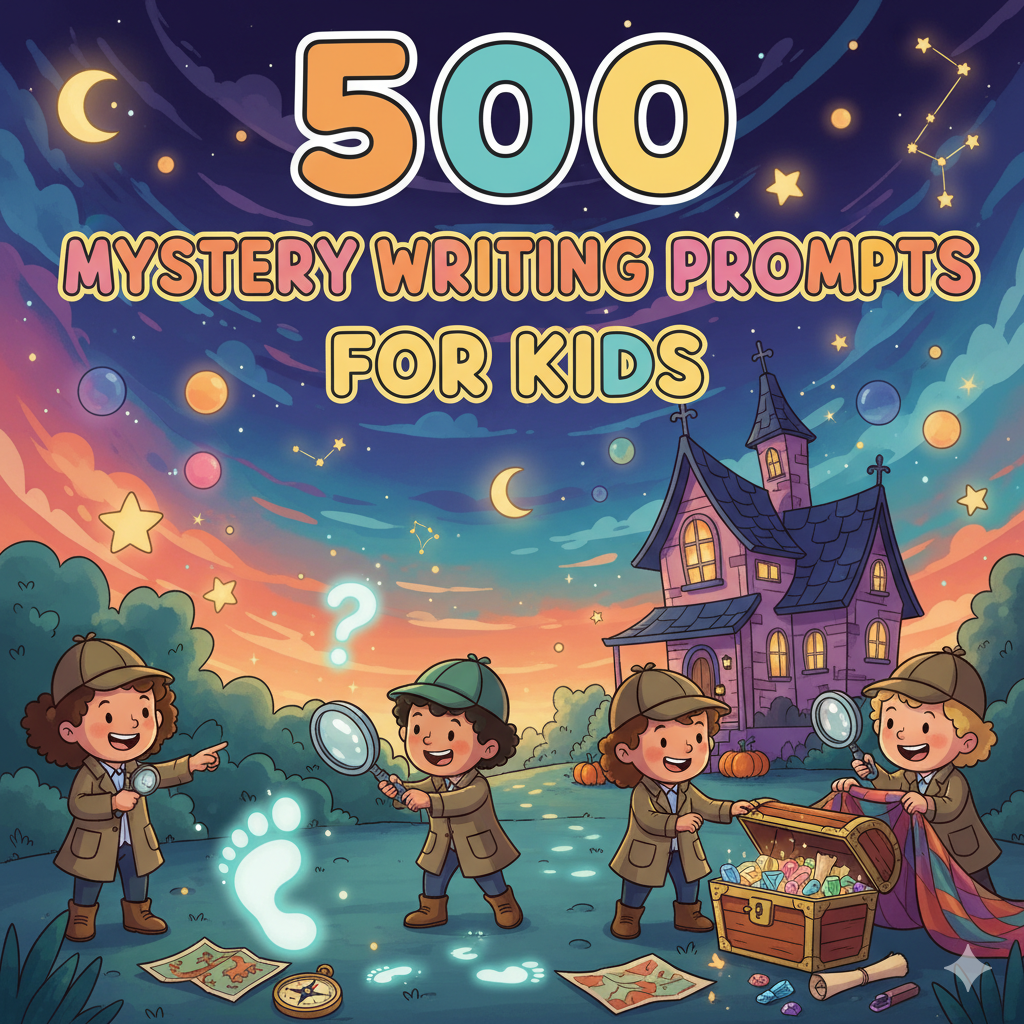
When I first came across “500 Mystery Writing Prompts,” I almost scrolled past it. I thought — okay, another generic list of story ideas, probably something a bored writer put together in a weekend. But then a teacher friend of mine mentioned she had been using it with her students to help them design their own books. Real, actual books. Not just random scribbles in a notebook, but structured, creative, meaningful story books that kids were genuinely proud of.
That stopped me in my tracks.
So I decided to dig deeper. And what I found genuinely surprised me.
This Isn't Just for Writers. It Never Was.
Here’s the thing most reviews get completely wrong about this collection — they treat it like it’s only for adult novelists or aspiring thriller writers. But that’s honestly a very narrow way of looking at it.
The real magic of 500 Mystery Writing Prompts is how perfectly it fits into the hands of three very different kinds of people: teachers who want to build engaging classroom material, parents who want to nurture their child’s creativity at home, and students who dream of writing their very own book but don’t know where to start.
Think about that for a second. How many kids have you seen who say “I want to write a book” — full of excitement — and then stare at a blank page and give up within ten minutes? It happens all the time. Not because the child isn’t creative. But because nobody gave them the right starting point.
That’s exactly what this collection does. It hands you the starting point on a silver platter.
500 Mystery Writing Prompts - $17
500 Mystery Writing Prompts steps in and honestly? It's been a game-changer for a lot of writers, from complete beginners to seasoned novelists hitting a creative wall.
500 prompts sounds like a lot — and it is. But before your eyes glaze over, let me explain how they’re organized, because this matters more than the number itself.
The prompts are grouped into clear categories. You’ve got classic mystery setups, detective-style scenarios, psychological puzzles, historical mysteries, supernatural twists, and lighter “cozy” mystery situations that are perfect for younger readers. Each category has a different mood, a different level of complexity, and a different kind of storytelling challenge.
For a teacher designing a classroom project, this variety is gold. You can pick a set of prompts that match your students’ age group and reading level. A prompt meant for a ten-year-old looks very different from one designed to challenge a high school student — and this collection covers both ends of that spectrum.
For a parent sitting with their child on a Sunday afternoon, the prompts work like a conversation starter. You don’t even have to call it “writing practice.” You just say — “Hey, what if a detective found a mysterious letter in the old library? What do you think happens next?” And suddenly your child is telling you a story. You write it down together. You draw pictures. You turn it into a book. Just like that.
The Teacher's Perspective
I spoke with three teachers who have used this collection in their classrooms, and the feedback was remarkably consistent.
One fifth-grade teacher told me she uses the prompts as a monthly “Book Design Challenge.” Each student picks one prompt, writes their story, illustrates it, and puts it together as a small handmade book. By the end of the school year, every child in her class has their own collection of original mystery books. She said — and I’m paraphrasing here — that she had never seen reluctant writers so motivated to sit down and actually finish something.
That’s not a small thing. Getting a ten-year-old to finish a piece of writing is genuinely hard. The right prompt makes all the difference.
Another teacher uses the prompts for group projects. She assigns a single prompt to a team of three or four students, and each group has to collaborate to design their book — deciding on characters, plot twists, illustrations, and even the cover design. It teaches creative writing, teamwork, and basic book design principles all at once. She described it as one of the most effective projects she’s run in fifteen years of teaching.
The third teacher — a high school English teacher — uses the more complex psychological mystery prompts as a tool for advanced students who want to self-publish their writing. The prompts give them a strong foundation, and from there, the students develop their own voice and build something genuinely impressive.
If you’re a parent reading this, let me speak directly to you for a moment.
You don’t need to be a writer to use this. You don’t need to know anything about storytelling structure or narrative arcs or any of that. All you need is a quiet afternoon, your child beside you, and one good prompt.
Here’s what I mean. One of the prompts in the collection reads something like: “A young girl finds a locked box under her grandmother’s bed. Inside is a letter addressed to someone who disappeared thirty years ago.”
Read that to your eight-year-old. Watch their eyes light up. Ask them — “Who do you think disappeared? Why did they leave? What does the letter say?” You’ll have more story than you know what to do with.
From there, the process of turning it into a book becomes a beautiful creative project you do together. Your child tells the story. You help them write it out. They draw the pictures. You help them put it together — whether that’s a simple stapled booklet or something more polished. The prompt was just the spark. The book is entirely theirs.
Parents who homeschool their children have found this collection especially valuable because it gives structure to creative writing sessions without feeling like forced homework. It’s play that happens to also be deeply educational.
The Student's Perspective
Now for the students themselves — particularly the older ones, middle school and above, who have big creative dreams but don’t always know how to channel them.
There is something uniquely powerful about a well-written prompt when you’re thirteen or fifteen and you desperately want to write a mystery novel but feel completely lost. You have energy. You have imagination. What you lack is direction.
500 Mystery Writing Prompts gives you that direction without being prescriptive. It doesn’t tell you exactly what to write. It opens a door and says — “Here’s an interesting room. Go explore it.”
Many students have used single prompts from this collection as the seed of an entire self-designed book project. Some have gone on to create illustrated short story books. Others have used the prompts to build out longer chapter books. A few ambitious students have even turned their prompt-based books into entries for school writing competitions — and done very well.
The prompts also work beautifully for students who struggle with creative writing. When you’re staring at a blank page and the prompt gives you a character, a setting, and a conflict already built in, you’re not starting from zero anymore. You’re already halfway there.
Does It Have Any Weaknesses?
Of course it does. Nothing is perfect.
Some prompts are stronger than others — that’s inevitable in a collection this large. A handful feel a bit generic, the kind of setup you might have seen a hundred times before. But here’s the thing: even a generic prompt can become a brilliant book in the right hands. The prompt is just the beginning. What you do with it is what matters.
The collection also doesn’t come with explicit guidance on how to design or bind a physical book. If your goal is to help a child create a proper designed book — with a real cover, formatted pages, and so on — you’ll need to supplement this with some basic book-design tutorials or templates. The prompts handle the creative content. The design process is a separate step.
A guide specifically for teachers and parents on how to structure a “prompt-to-book” project would make this collection truly complete. That’s the one addition I’d genuinely love to see in a future edition.
So, Is It Worth It?
Short answer: absolutely yes.
If you’re a teacher looking for a creative, flexible tool to help your students design and write their own books — this is one of the best resources you can find at this price point. If you’re a parent who wants to encourage your child’s love of storytelling and turn it into something real and tangible, this collection will give you everything you need to get started. And if you’re a student who has always wanted to write your own mystery book but didn’t know how to begin, these prompts are exactly the push you’ve been waiting for.
500 prompts means five hundred doors. You only need to walk through one to find your story.
MyBlogGuides is your go-to platform for simple, fast, and free online tools. Easily access useful utilities designed to save time, boost productivity, and simplify everyday tasks all in one place.