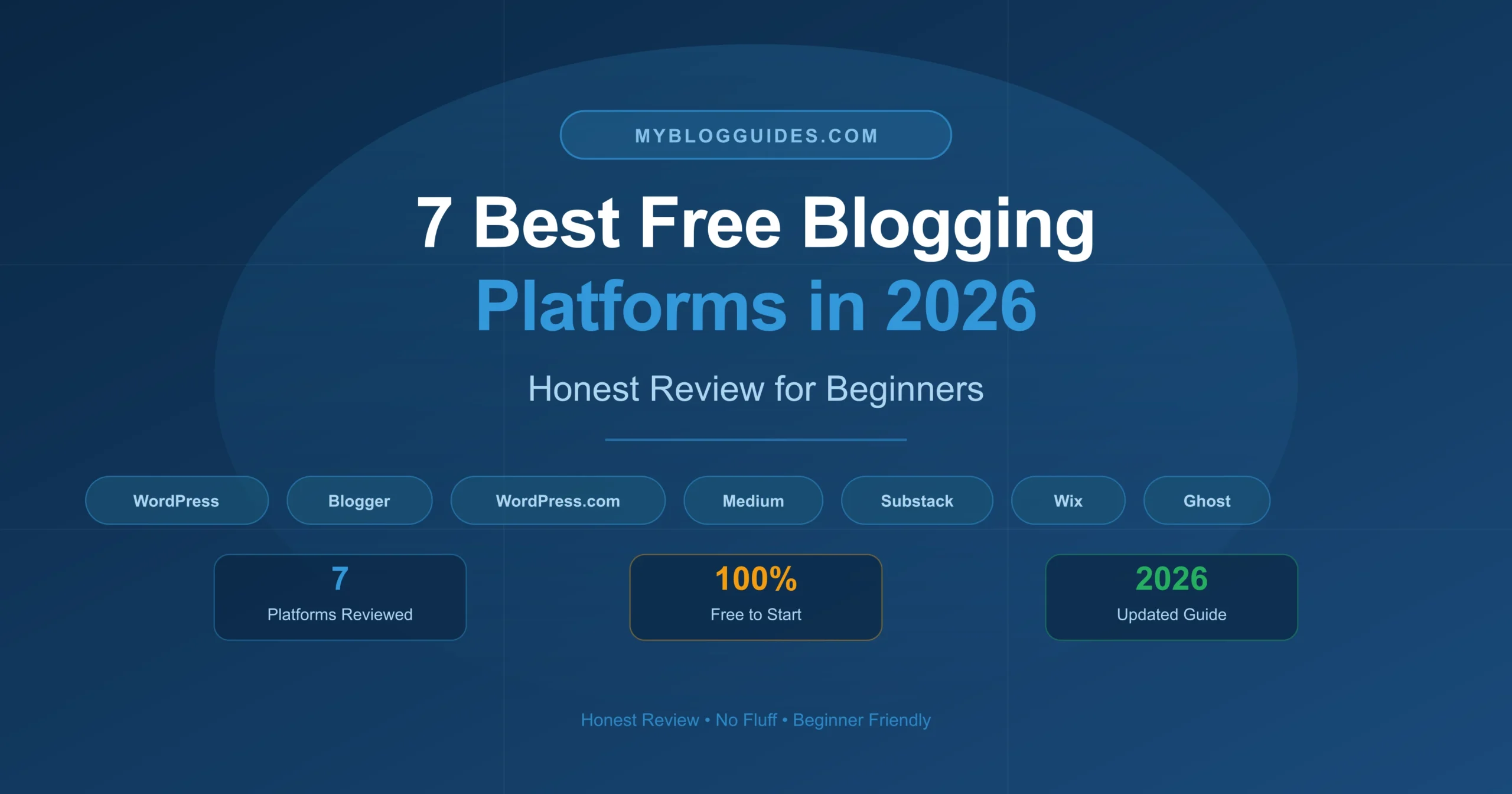
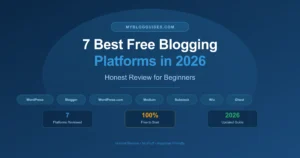
7 Best Free Blogging Platforms in 2026 You Will Love Using!

7 Best Free Blogging Platforms in 2026

Table of Contents

Skill Level
99%

Choosing a blogging platform feels like it should take five minutes. It does not. I spent almost two weeks on this decision when I started reading article after article that all said the same useless thing: ‘it depends on your goals.’

Thanks. Very helpful.

So I actually went and tried most of them myself. Some were genuinely great. Some I deleted within a week. And a couple surprised me in ways I did not expect.

This is the honest breakdown I wish someone had written for me back then. No sponsored picks, no platform paying me to say nice things about them. Just real talk about what each one is actually like to use especially when you are starting from scratch with no budget and no tech skills.

Let us get into it.

Before We Start One Question You Need to Answer

Everything about choosing a blogging platform comes down to this one question: are you blogging as a hobby, or do you actually want to earn money from it?

Because the answer changes everything.

Hobby blogger who just wants to share thoughts and does not care about income? Almost any platform will work fine. Serious about building an audience and earning from ads, affiliate links, or sponsored posts? Then your platform choice matters a lot and getting it wrong costs you time.

Answer this honestly before reading on. It will save you from making a decision you regret in six months and having to migrate everything.

The 7 Best Free Blogging Platforms in 2026

Best Free Blogging Platforms

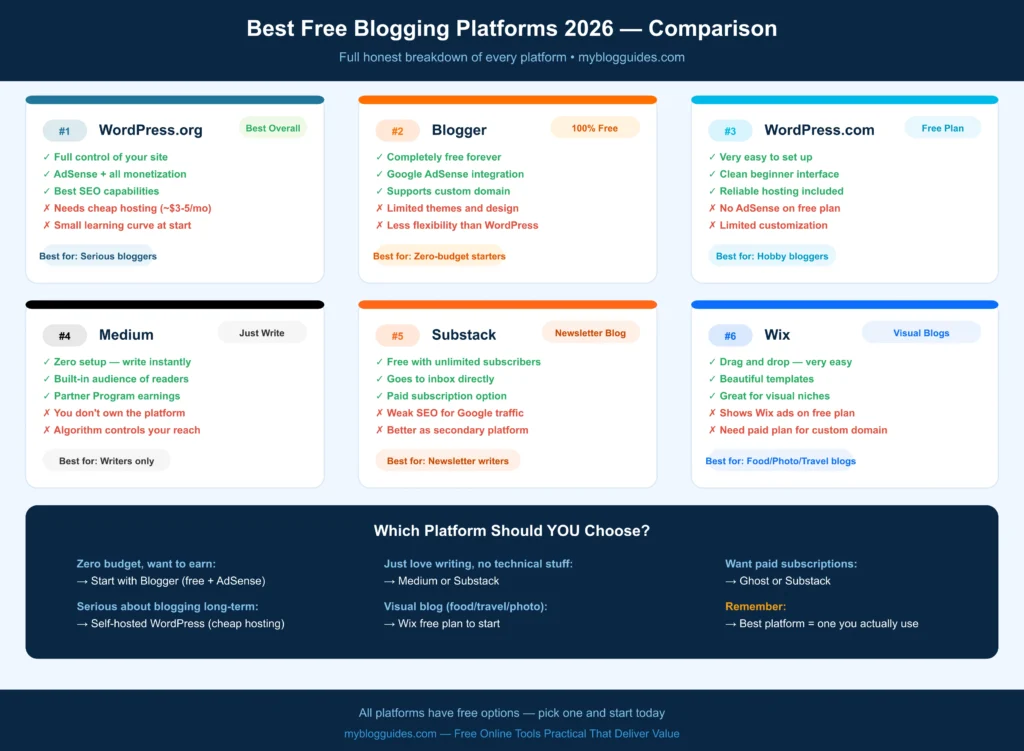
1. WordPress.org The One Almost Everyone Ends Up On

I am going to be straight with you. WordPress.org is not technically free. You need web hosting which costs around three to five dollars a month. But I am including it here because it is so far ahead of everything else that it would be dishonest not to mention it and the cost is genuinely tiny.

Over 40 percent of the entire internet runs on WordPress. There is a reason for that. It is powerful, flexible, and gives you complete ownership of everything you build.

  • You own your site completely no platform can delete it or change the rules on you tomorrow
  • Works with Google AdSense and every other ad network without any restrictions
  • Thousands of free themes and plugins so you can build exactly what you want
  • Best SEO Tools available especially with the free Yoast plugin installed
  • Can grow from a personal blog to a full business without switching platforms

Honest warning: The first week on WordPress feels a bit overwhelming. There are settings everywhere and it takes time to figure out how things connect. Push through it. I promise it gets easy fast and the payoff is massive.

If earning money from your blog is the goal even eventually just start on WordPress from day one. The cheap hosting cost is worth it. Almost every blogger who starts on a free platform ends up moving to WordPress anyway. Might as well save yourself the migration headache.

2. Blogger The Best Genuinely Free Option

Blogger is owned by Google and it costs absolutely nothing. No hosting fees, no subscriptions, no surprise charges. You get a free yourblog.blogspot.com address and you can connect a custom domain whenever you are ready you just pay for the domain itself which is around ten dollars a year.

I actually used Blogger myself for my first few months. Honest verdict? It is simple, reliable, and does exactly what it says. I had my blog live in about twenty minutes with zero technical knowledge.

  • Completely free with Google’s infrastructure behind it your site is extremely unlikely to go down
  • Direct integration with Google AdSense no complicated workarounds needed
  • Simple clean interface that does not overwhelm beginners
  • Supports custom domains so you can look professional without paying for hosting
  • Been around since 1999 Google is not shutting this down anytime soon

The honest downsides: Blogger has not been seriously updated in years. The design options feel a bit dated. You are more limited in what you can do compared to WordPress and the SEO options are more basic.

My real recommendation: Start on Blogger if you have zero budget. Learn how blogging and SEO work. Once you start making a little money or feel genuinely committed, move to self-hosted WordPress. This is exactly the path I took and it works.

3. WordPress.com Easy but Limited

This one confuses everyone and honestly the naming is a bit misleading. WordPress.com and WordPress.org share the same name but they are very different products. WordPress.com is a hosted service you sign up, pick a theme, and start writing. No technical setup at all.

The free plan gets you a yourblog.wordpress.com address and a clean simple editor. It is genuinely easy to use.

  • Extremely beginner-friendly literally just sign up and start writing
  • Clean well-designed interface that feels modern
  • Good reliable hosting included at no cost
  • Large WordPress community so help is easy to find

Here is the catch that stops most bloggers: you cannot run ads on the free plan. No AdSense, no monetization whatsoever. To earn from your blog you need to upgrade to a paid plan which starts around four dollars a month. If earning money is your goal, Blogger gives you that for free. WordPress.com does not.

4. Medium For Writers Who Just Want to Write

Medium is a completely different kind of platform. Forget themes, settings, plugins, and all that. Medium is just a clean beautiful place to write. You sign up and start publishing. That is it.

The reading experience on Medium is genuinely lovely. No clutter, no distracting ads, just content. And because Medium has millions of existing readers, there is a real chance your articles get discovered by people who would never find you otherwise.

  • Zero setup you can publish your first article within ten minutes of signing up
  • Built-in audience of readers who are actively looking for good content
  • Medium Partner Program pays you based on how long paying members read your work
  • Clean distraction-free writing and reading experience

The big problem with Medium that nobody talks about enough: you do not own your platform. Medium controls your reach. Their algorithm changes, your traffic changes. Several writers I know went from thousands of monthly readers to almost nothing overnight after a Medium algorithm update. You are building on rented land.

Use Medium as a secondary channel, not your main home. Publish your articles on your own blog first, then share them on Medium for extra reach. Never put all your content somewhere you do not control.

5. Substack If You Love the Newsletter Format

Substack has blown up over the last few years and it deserves the attention. The idea is simple: you write posts and they go directly to your subscribers’ email inboxes. It is blogging crossed with email newsletters and it works really well for certain types of content.

The free plan is genuinely generous. You can grow your subscriber list to any size and send unlimited content at no cost. Substack only takes a percentage if you charge readers for paid subscriptions.

  • Free to use with no subscriber limit build your audience without paying
  • Your content goes directly to inboxes, bypassing social media algorithms completely
  • Clean simple writing interface no distractions
  • Built-in option to charge for premium content when you are ready
  • Growing community of readers who specifically look for Substack writers to follow

Where it falls short: Substack is not built for Google search traffic. If you want people to find you through Google when they search for topics, Substack is not your best tool. It works brilliantly for building a direct loyal audience but SEO is not its strength.

The smart play is to use Substack alongside your main blog. Your WordPress or Blogger site catches people through Google search. Your Substack keeps your most loyal readers connected directly through email. Both working together is powerful.

6. Wix If Your Blog is Heavily Visual

Wix is primarily known as a website builder rather than a blogging platform. But if your blog is going to be very visual think food, travel photography, fashion, lifestyle Wix is genuinely worth looking at. The drag and drop editor is satisfying to use and the templates look professional.

  • Drag and drop editor makes design feel fun rather than frustrating
  • Hundreds of templates including designs built specifically for blogs
  • Great for niches where visuals matter as much as words
  • App market lets you add features as your blog grows

The free plan shows Wix branding on your site and does not let you use a custom domain. For a professional blog you would eventually need a paid plan. Also Wix's SEO, while decent, is not as strong as WordPress for pure search traffic. If Google traffic is your main growth strategy, WordPress serves you better long term.

7. Ghost The One for Serious Writers

Ghost is newer than the others and has built a strong reputation among professional writers, journalists, and creators who want to monetize directly through reader subscriptions. It is fast, beautiful, and completely focused on the writing and publishing experience with no distractions.

The hosted version requires a paid plan, but Ghost is open source which means you can self-host it on a cheap server if you are comfortable with a little technical setup.

  • Exceptionally fast loading one of the best reading experiences available
  • Built-in membership and paid subscription tools
  • Clean writing interface with no unnecessary clutter
  • Good SEO foundations built right in

Honestly, Ghost makes most sense for writers who already have an audience and want to monetize through subscriptions. For a beginner starting from scratch, it is a bit more platform than you need right now. Worth coming back to later.

If you are genuinely unsure, pick Blogger. It is free, it works, it connects to AdSense, and you can always move to WordPress later once you know blogging is something you want to commit to. Done is better than perfect.

Can You Actually Make Money with These Free Platforms?

Short answer: yes, but it depends which one you pick.

Blogger is probably the most monetization-friendly free option. The AdSense integration is direct and straightforward. Once your blog meets Google’s requirements you can apply and start showing ads. Many bloggers earn consistently from Blogger without ever upgrading to anything.

WordPress.com free plan blocks monetization entirely. You need a paid upgrade which sort of defeats the purpose if budget is the concern.

Medium pays through their Partner Program but the earnings are unpredictable. Some writers earn meaningfully, others earn almost nothing for the same amount of work. The algorithm is opaque and the results vary wildly.

Substack lets you charge readers for paid newsletters. This works really well in certain niches and poorly in others. Building a paying subscriber base takes time but the potential is real.

Self-hosted WordPress gives you the most options with zero restrictions. AdSense, affiliate marketing, sponsored posts, selling courses or digital products all of it is possible with no platform getting in the way.

Frequently Asked Questions (FAQs)

Yes. It looks a bit old compared to newer platforms but it does the job. It is free, it is Google-owned so it is reliable, and the AdSense integration is cleaner than on most other free platforms. For a zero-budget beginner it is still a solid choice.

Yes, and it is more common than you think. Moving from Blogger to WordPress is a well-worn path with proper migration tools available. The earlier you do it the easier it is though. Once you have hundreds of articles it becomes a bigger project. If you already know you want WordPress eventually, honestly just start there.

They can. Google does not penalize free subdomains. But custom domains do tend to perform better over time. If you are serious about Google search traffic, getting a custom domain whether on Blogger, WordPress.com paid, or self-hosted WordPress makes a genuine difference in the long run.

Realistically six to twelve months of consistent work. Sometimes faster in certain niches, sometimes slower. The bloggers who actually get there are the ones who kept writing after month three when growth felt invisible. That patience is the real barrier, not the platform.

One Last Thing

The platform genuinely matters less than most beginners think. I have seen people make great blogs on Blogger and terrible blogs on expensive WordPress setups. The words and the consistency are what build an audience. The platform is just the container.

Pick one today. Not tomorrow. Today. Write your first post this week. The imperfect blog you actually start will always beat the perfect blog you are still planning.

Whatever you choose Blogger, WordPress, Medium, Substack commit to it for at least six months before you judge whether it is working. Real results take real time.

Now go start.

Leave a Reply