1-Hour AI Traffic Machine Review Is the Hype Even Justified?
- June 15, 2026
- No Comments
Here’s a sentence that should worry anyone running a content or SEO-driven business in 2026: Google’s AI Overviews now show up on roughly half of all search queries, and the organic click-through rate on those affected searches has dropped by more than 60%.
That’s not a future problem. That’s the current state of search. And it’s why even companies with genuinely excellent SEO teams HubSpot being the most-cited example, having lost 70-80% of their organic traffic in a single year are scrambling to figure out what comes next.
1-Hour AI Traffic Machine is a 3-day live training built directly around that shift. Co-hosted by Neil Napier and Chris Munch, it’s framed around teaching a structured AI implementation system for generating free, compounding traffic the kind that doesn’t evaporate the moment an algorithm update lands, because it’s distributed across multiple channels rather than depending entirely on one search engine’s goodwill.
I went through everything the framework, the daily curriculum, the case studies, the included tools, the bonus stack, and the full pricing structure across the front-end and both upgrades. This review covers all of it, with an honest read on what’s solid and what to keep in perspective.
What Is 1-Hour AI Traffic Machine, Exactly?
At its core, this is a 3-day live training event, scheduled for June 19-21, 2026, co-hosted by Neil Napier and Chris Munch. The central teaching framework is what they call the 3-Level AI Implementation Framework a structured progression for using AI to generate traffic, broken into four stages:
- Level 0 Basic ChatGPT prompts. This is where the framework says most people get stuck using AI in the most surface-level way possible and wondering why results are mediocre.
- Level 1 Expert-trained AI prompts. Prompts that have been refined and tested specifically for content and traffic generation, rather than generic queries.
- Level 2 Automated workflows. Connecting AI tools into sequences that handle multiple steps of content creation and distribution without manual repetition.
- Level 3 Complete multi-agent systems. The most advanced stage multiple AI agents working together across a workflow, approaching something closer to an automated content and distribution operation than a single tool being used repeatedly.
The framework itself is built on top of Chris Munch’s AmpiFire content distribution methodology something he’s been refining for over 15 years, well before “AI” was part of the conversation. What’s being taught here is essentially that methodology, updated and accelerated with AI tools layered into each step.
One detail that’s worth highlighting: the training is positioned as working across any niche, business model, or product type and the proof points provided (which we’ll get into) span an unusually wide range of industries, from fitness equipment to medical devices to children’s toys to wine. That breadth is either a strong signal that the underlying methodology is genuinely generalizable, or it’s the kind of case study spread that comes from a methodology having been applied across a large number of client accounts over many years. Given the 15-year AmpiFire background, I’d lean toward the latter being the more accurate framing and that’s actually a point in its favor, because it suggests the framework has been pressure-tested across a wide range of real business contexts rather than being theoretical.
The Search Landscape Shift Why This Training Exists Right Now
Before getting into the curriculum and the offer structure, it’s worth spending real time on the context this training is responding to, because it’s not hype it’s a documented, ongoing shift in how search works.
AI Overviews the AI-generated summary boxes that now appear at the top of a large share of Google search results answer the user’s question directly on the search results page itself. For a huge number of queries, that means the user gets their answer without ever clicking through to a website. The traffic that used to flow to the websites that historically ranked for those queries simply… doesn’t happen anymore, for a meaningful share of searches.
The HubSpot example is striking precisely because of who it is. HubSpot has one of the most resourced, most experienced SEO and content teams in the entire marketing industry. If a team like that can lose 70-80% of organic traffic in a year despite doing everything “right” by traditional SEO standards, that’s a clear signal that the rules changed underneath everyone not that any particular team did something wrong.
The framing in this training is that the marketers who are still winning under these conditions aren’t the ones doubling down on traditional SEO and hoping it recovers. They’re the ones running multi-channel systems distributing content across many platforms simultaneously, so that no single algorithm change (Google, YouTube, social platforms, or anything else) can wipe out their visibility overnight. If you’re getting traffic from 300 different places in small amounts, losing any one of them barely registers. If you’re getting 80% of your traffic from one source, losing that source is close to existential.
That’s the structural argument underlying the whole training: not “AI will make you rich quick,” but “the way traffic worked for the last 15 years is breaking down, and here’s a system built for how it works now distributed, AI-assisted, and not dependent on any single platform’s algorithm.”
1-Hour AI Traffic Machine - $27
1-Hour AI Traffic Machine $27 for three days of live training from people with a genuinely long track record, built on a methodology that's already survived more than a decade of search and platform changes, this is a low-cost way to get a structured response to a problem that almost every content-driven business is dealing with right now, whether they've fully recognized it yet or not.
Visit Official Site + Bonus!The Case Studies A Closer Look at the Numbers
The proof points provided span eight different industries, and I want to go through these properly rather than just listing them, because the range itself tells you something about how broadly applicable the underlying methodology is claimed to be.
|
Niche
|
Result
|
Details
|
|---|---|---|
|
Fitness Equipment
|
61.5x ROI
|
$5K/mo spend → $307.5K/mo in sales → $3.6M+ total, vs $100M+ ad budgets, $0 paid ads
|
|
Medical Device
|
Millions in Sales
|
Traffic grew 1,500 → 10,000+ visitors/mo in 8 weeks. Ranked above Amazon, all organic
|
|
Children's Toys
|
$730K in Sales
|
Top 3 revenue year in 20 years of business. 123K+ video views on a brand new channel
|
|
Bedroom Furniture
|
+417% Traffic
|
35 content campaigns. 1,470 → 7,600+ visitors/mo. Rankings 705 → 1,732 in 14 months
|
|
Fine Wines
|
+1,100% Growth
|
$0 ad spend. $70,000 in new attributed sales. 140,000 impressions/month
|
|
Home Robotics
|
+195% Traffic
|
Outranked Amazon in under 12 months
|
|
Premium Watches
|
Outranked Apple
|
180 → 2,035 visitors in 90 days. Traffic value equal to $19.7K/mo PPC
|
|
Windows & Doors
|
$6K from 98 Clicks
|
One competitor analysis post generated $6,000 in ROI from a single page
|
A few of these are worth sitting with for a moment longer.
The fitness equipment result a 61.5x return on a $5K/month spend, scaling to $307.5K/month in sales and $3.6M+ total, while competing against brands with $100M+ advertising budgets and spending $0 on paid ads is the headline number, and for good reason. Competing against companies with two orders of magnitude more advertising budget, using a $0 paid traffic strategy, and winning, is the kind of result that either represents an enormous methodology advantage or an enormously favorable niche (or both). Either way, it’s the kind of case study that earns attention.
The medical device example is notable for a different reason: ranking above Amazon, organically, for relevant search terms. Amazon’s domain authority is about as high as it gets outranking Amazon organically in any category is genuinely difficult, and doing it in under 8 weeks while scaling traffic from 1,500 to over 10,000 monthly visitors suggests the content and distribution strategy is doing something that standard SEO approaches typically can’t replicate that quickly.
The premium watches case outranking Apple, going from 180 to over 2,035 visitors in 90 days, with the resulting traffic valued at the equivalent of $19.7K/month in PPC spend follows the same pattern: a brand with enormous domain authority (Apple) being outranked by a smaller player using this methodology.
And the windows and doors example $6,000 in ROI from a single competitor analysis blog post that generated only 98 clicks is the one that I think best illustrates the underlying philosophy of the whole approach. This isn’t about massive traffic volume as the goal. It’s about the right content, targeting the right audience, with the right distribution to the point where 98 clicks can generate $6,000. Volume matters less than relevance and intent when the content and distribution strategy is dialed in correctly.
Taken together, these case studies span ecommerce (fitness equipment, toys, furniture, wine, watches), B2B-leaning categories (medical devices, home robotics), and local/service-oriented businesses (windows and doors). That spread is what supports the “works across any niche or business model” claim though as with any case study collection, these represent specific results from specific implementations, and individual results will vary based on execution, niche competitiveness, and how closely the framework is followed.
The 3-Day Curriculum What You'll Actually Learn
Day 1: AI Mastery Foundations
The first day is about establishing the framework itself walking through the full 3-Level AI Implementation Framework from basic prompts through to multi-agent systems, so you understand the entire progression before diving into specifics. It also covers the three best ways to actually monetize AI-generated traffic (traffic alone isn’t a business model converting it is), and a practical walkthrough of which AI tools are actually worth paying for versus which free tools get you most of the way there. That last point matters more than it might seem the AI tool landscape changes constantly, and having a current, practical assessment of what’s actually useful (rather than what’s just heavily marketed) saves a lot of wasted time and money.
Day 2: Strategic AI Implementation
This is where the AmpiFire methodology specifically comes into focus a 3-step content formula that’s reportedly been generating millions of visitors over 15+ years and is described as still working in 2026, now with AI integrated into the execution. The emphasis on “still working” is doing real work here: a huge amount of marketing advice has a shelf life measured in months as platforms and algorithms change. A formula with a 15-year track record that’s been adapted rather than replaced is a meaningfully different proposition than “here’s a new trick.”
The day also covers topic selection specifically, how to choose topics that attract buyers rather than browsers, which is the difference between traffic that converts and traffic that just inflates your analytics and the multi-platform publishing approach that underlies the “300+ platforms” distribution model mentioned earlier. This is likely the most directly actionable day of the three, since it’s where the core content and distribution strategy gets taught in detail.
Day 3: Advanced AI Concepts & Possibilities
The final day moves into the more forward-looking territory building AI advisors and automated workflows that can handle business tasks beyond just content and traffic, the daily and weekly planning systems the AmpiFire team itself uses to manage this kind of work at scale, and how to connect AI tools into workflows that run with minimal ongoing supervision.
This day is essentially the “Level 2 and Level 3” content from the framework moving from manually-run AI-assisted processes toward genuinely automated systems. For attendees who are newer to AI tools generally, this day will likely feel the most aspirational; for attendees who’ve already got Level 0 and Level 1 handled in their own business, this is probably the day with the most new, directly applicable material.
The 3 AI Traffic Tools A Sequential Research System
Beyond the training itself, the front-end package includes access to three AI tools that are described as working together as a sequential research system and there’s an important detail here: these tools are included for a limited time only, and once that window closes, they’re removed from the package entirely.
Niche Goldmine AI
The first step in the sequence identifying your most profitable sub-niche before creating any content at all. This addresses one of the most common and costly mistakes in content marketing: spending weeks or months producing content for a sub-niche that turns out to have weak buyer intent or excessive competition, only discovering this after the fact. Front-loading this analysis means your subsequent content effort is aimed at a target that’s actually worth hitting.
Viral Trigger AI
The second step once you know your sub-niche, this tool surfaces the angles, topics, and formats that people in that niche are already actively sharing, engaging with, and searching for. Rather than guessing what might resonate, this is about identifying what’s already demonstrably resonating and building from there. This is a meaningfully different (and more reliable) starting point than purely creative brainstorming.
Buyer Magnet Headlines
The third step translating the niche and angle insights from the first two tools into headlines specifically engineered to attract people who are ready to act, as opposed to people who are just casually browsing. The distinction between buyer-intent traffic and browser traffic comes up repeatedly throughout this training, and this tool is the most direct, tactical application of that principle it’s literally baked into the headline-generation process.
As a system, these three tools map cleanly onto the “choose topics that attract buyers, not browsers” principle from Day 2 niche selection, angle validation, then headline optimization, in that order. The limited-time inclusion is worth being aware of when deciding on timing: if these tools are part of what makes the offer appealing to you, that’s a reason to not let this sit indefinitely before deciding.
Pricing The Full Funnel Breakdown
|
Plan
|
What You Get
|
Price
|
Access
|
|---|---|---|---|
|
Front End
|
3-Day LIVE Training
|
$27
|
|
|
OTO 1
|
VIP Upgrade
|
$97
|
|
|
OTO 2
|
Inner Club
|
$197
|
Front-End 3-Day Live Training: $27
For $27, you get full access to all three days of live training (June 19-21, 2026), the three AI traffic tools described above (for the limited window they’re included), and a solid bonus package: 24-hour replay access after each session, cliff note summaries (useful if you want the key takeaways without re-watching full sessions), access to a private Facebook community, an extra seat for a partner or spouse, and complete session transcripts.
At $27, the access to live, co-hosted training from two people with this level of track record plus working tools and a community is a genuinely low-friction entry point. The 24-hour replay window is worth noting specifically: if you can’t attend live, or want to revisit a session, you have a day to do that before it’s gone at the front-end tier which is where OTO1’s extended replay access becomes relevant if ongoing reference material matters to you.
OTO 1 VIP Upgrade: $97
The VIP tier adds a meaningful layer of post-training support and extended access. The additional VIP Q&A session a dedicated post-training deep dive with Neil and Chris specifically is valuable because live training Q&A is often time-constrained; a dedicated follow-up session means questions that come up after you’ve had time to actually start implementing get addressed, not just questions that come up during the live sessions themselves.
Extended 30-day replay access (versus 24 hours at the front-end) is the practical difference that matters most for anyone who learns better by rewatching material, or who wants to implement at their own pace rather than racing to absorb everything during the live window. The Elite Implementation Workbook gives structure to that implementation process, and the 1-on-1 AI Traffic Strategy Call is the most individually valuable component a direct strategy session means the framework gets applied to your specific business and niche, rather than you having to figure out that translation yourself.
The 30 days of AI Traffic Reviews inside the Facebook community is also worth highlighting ongoing feedback on your implementation over a month-long period is a meaningfully different support structure than a single Q&A session, since it accounts for the reality that implementation happens over weeks, not in the days immediately following a training.
On top of all that, OTO1 includes a bonus AI tools suite: two expert advice chatbots, a sales page writer, an email campaign writer, an SEO AI process tool, and Facebook ad writers. These are general-purpose marketing AI tools that extend beyond the traffic-specific focus of the core training useful additions if you’re handling multiple aspects of marketing yourself.
OTO 2 Inner Club: $197
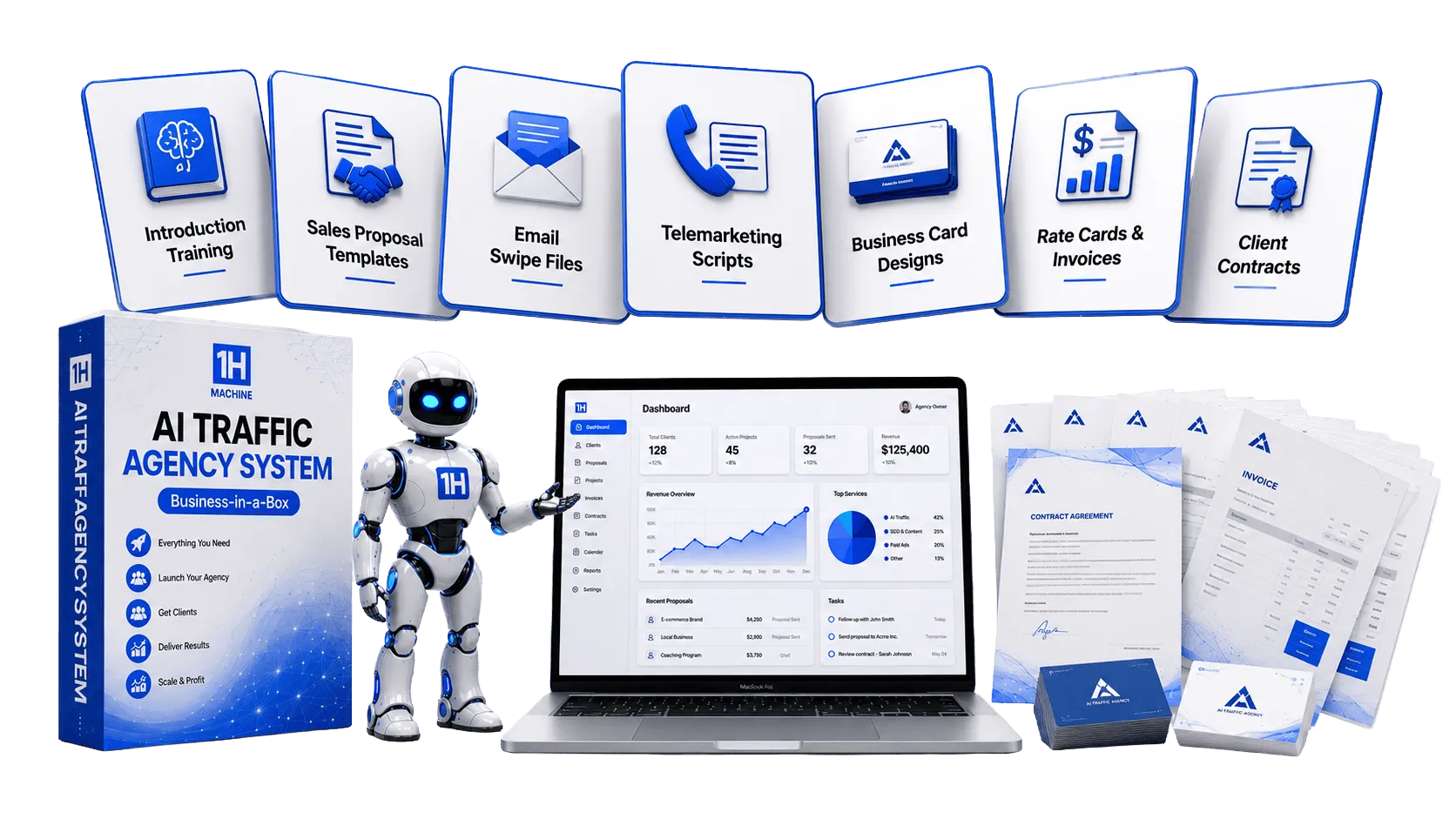
This is the tier built for people who want to turn this methodology into an actual service offering “AI Traffic as a Service.” Beyond lifetime access to all training recordings and elite community status, the core addition here is a complete done-for-you asset library specifically for running a traffic generation agency: client proposals, email swipes, sales scripts, business cards, rate cards, letterheads, invoices, and client contracts essentially the entire paperwork and sales infrastructure needed to start offering traffic generation as a paid service to clients, without building any of that from scratch.
On top of the DFY agency assets, the Inner Club includes the AI Domination Suite seven complete courses covering AI Copy Domination, AI Social Domination, AI Repurpose Domination, AI Local Domination, AI Course Domination, AI Webinar Domination, and AI Offer Domination. That’s a substantial amount of additional training material, each focused on applying AI to a specific area of marketing and business repurposing content across formats, local business marketing, course creation, webinars, and offer development.
For context: seven complete courses plus a full agency asset library, on top of lifetime training access, at $197, represents a significant amount of material. The practical question for this tier isn’t really “is there enough here” it’s “do you specifically want to build a traffic-as-a-service offering for clients, or apply this primarily to your own business.” If the former, this tier is built directly for that. If the latter, the front-end plus OTO1 likely covers what you need without the agency-specific assets.
The Bonus Library What Else Is Included
Beyond the tier-specific bonuses, there’s a broader library of named bonuses referenced as part of the overall package covering a wide range of marketing functions: Short Form Hook Formula, 500 ChatGPT Marketing Prompts, YouTube SEO Keyword Sniper, Viral Video Title Generator, VSL Storyboard Builder, Subject Line Split-Test Generator, Programmatic SEO Content Engine, Pitch Perfect Positioning, a B2B Cold DM Swipe File with 50 scripts, a LinkedIn Outreach Sequence Builder, a Pre-Launch Hype Formula, a collection of top subject lines, a set of affiliate marketing emails, and an Advanced Webinar Framework.
A few of these connect directly back to the core training’s themes. The Programmatic SEO Content Engine pairs naturally with the multi-platform distribution strategy from Day 2. The Short Form Hook Formula and Viral Video Title Generator extend the “buyer magnet headlines” concept into short-form video, which is one of the platforms most likely to be part of a genuinely multi-channel distribution strategy in 2026. And the 500 ChatGPT Marketing Prompts bonus is a practical complement to the Level 0-to-1 progression in the framework a library of refined prompts is exactly the kind of resource that helps someone move past “basic ChatGPT prompts” without having to develop expert-level prompting skills from scratch through trial and error.
As with any large bonus library, the practical approach is the same as it always is: don’t feel obligated to use everything immediately. Identify the two or three bonuses that most directly support what you’re trying to do with the core training, and treat the rest as a reference library to come back to as your implementation progresses.
Who Is This Actually For?
The training is positioned for a fairly wide range of audiences, and I think that’s largely accurate though some groups will get more out of it than others, depending on where they’re starting from.
- Complete AI Beginners: The structured progression from Level 0 through Level 3 is specifically designed for this audience no coding or technical background required, with the framework explicitly built to take you from the most basic starting point forward.
- Busy Business Owners: The emphasis on automated workflows that generate traffic without daily effort directly addresses the core constraint busy owners have time. The Level 2/3 material on Day 3 is where this audience will find the most relevant content.
- Online Entrepreneurs: The free, compounding visibility angle building traffic assets that continue working over time rather than requiring continuous ad spend is core to the entire training’s value proposition.
- Coaches and Course Creators: Consistent, qualified leads that are pre-warmed before they reach you is particularly relevant for anyone selling higher-ticket coaching or courses, where lead quality matters as much as lead volume.
- Digital Marketers: For marketers already doing this work manually, the automation and multi-agent system concepts (Levels 2-3) represent the clearest path to scaling output without proportionally scaling time investment.
- Agency Owners: OTO2’s complete DFY asset library for traffic-as-a-service is built specifically for this group the methodology plus the business infrastructure to offer it as a client service.
- Social Media Managers: The multi-platform distribution approach maps directly onto social media management work, with AI-powered distribution multiplying output without multiplying hours worked.
The honest read: this is genuinely structured to meet people at different starting points, which is a real strength of how the Level 0-3 framework is designed. But the people who’ll get the most value fastest are those who already have some kind of content or traffic-generation activity happening even if it’s basic since the framework is fundamentally about leveling up an existing activity rather than starting one from absolute zero. Complete beginners can absolutely use this as their starting point too; it’s just that the “compounding” part of compounding traffic takes some time to build regardless of where you start, and having even a small existing base accelerates that.
Honest Assessment What's Strong, and What to Keep in Perspective
Here’s my straightforward take after going through everything.
What’s genuinely strong: the framing around the search landscape shift is accurate and well-supported AI Overviews reducing organic click-through rates, and major brands losing significant organic traffic despite strong SEO execution, are documented, real phenomena, not invented urgency. Building a training around “here’s a system designed for how search and traffic actually work now” is a sound premise, not a manufactured one.
The Level 0-3 framework structure is also a genuinely useful mental model, independent of anything else in the training. A huge number of people using AI for content and marketing are stuck at Level 0 basic prompts, inconsistent results without a clear sense of what “better” looks like. Having an explicit progression, with Level 3 (multi-agent systems) as a tangible target, gives people something concrete to work toward rather than vague “use AI more” advice.
The case studies span a genuinely wide range of industries, which supports the “works across any niche” framing better than a narrow set of similar examples would. And the AmpiFire methodology’s 15-year track record is a real differentiator this isn’t a system built around a single recent AI tool that might be obsolete in six months; it’s an established content distribution approach that’s being updated with AI rather than replaced by it.
What to keep in perspective: case study results especially standout numbers like 61.5x ROI or outranking Amazon represent specific outcomes from specific implementations in specific niches at specific points in time. They demonstrate what the methodology is capable of producing under the right conditions, but individual results depend heavily on your niche’s competitiveness, your starting point, your consistency of execution, and factors specific to your business that no training can account for in advance. Treat these as evidence the methodology works, not as a guaranteed outcome.
Also worth noting: “compounding” traffic, by definition, compounds meaning the biggest results in the case studies (the $3.6M+ totals, the 14-month ranking improvements) reflect sustained effort over meaningful time periods, not overnight results. The training teaches a system, and systems require consistent application to compound. If you’re looking for something that produces significant traffic within days of the training ending, that’s not really what’s being offered here and to be fair, the training itself doesn’t claim that. The framing is explicitly about building a permanent, system-based approach, which is a multi-week-to-multi-month proposition by nature.
On the 3 AI tools: the limited-time inclusion is worth factoring into your timing decision, but it’s also worth remembering that the tools are described as a sequential research system supporting the broader strategy the strategy itself (taught across the 3 days) doesn’t disappear if the tools eventually do. The tools accelerate and streamline specific steps; the underlying approach is the more durable asset.
Final Verdict Is It Worth the $27?
At $27 for three days of live training co-hosted by people with a genuinely long track record in this space, plus working tools and a solid bonus package, the front-end is about as low-risk as live training pricing gets. Even setting aside everything else, getting direct exposure to how Chris Munch’s AmpiFire methodology has been adapted for the current AI and search landscape from someone who’s been refining that methodology for 15+ years is worth the price of entry on its own.
For the upgrades: OTO1 (VIP, $97) is the one I’d consider most strongly for anyone planning to actually implement what’s taught, mainly because of the 1-on-1 strategy call and the 30 days of community feedback implementation support during the weeks after a training is often where the real value gets unlocked or lost, and this tier is specifically built around that period. OTO2 (Inner Club, $197) is a different decision entirely it’s the right choice specifically if building a traffic-generation service for clients is part of your plan, given the complete DFY agency asset library and the additional seven-course AI Domination Suite. If that’s not your goal, the front-end plus OTO1 likely covers what you need.
Given the live training is scheduled for June 19-21, 2026, the practical consideration is timing both for the live session dates themselves and for the limited-time inclusion of the three AI traffic tools. If the search landscape shift described here matches what you’ve been seeing in your own traffic numbers and for a lot of businesses right now, it does this is a reasonably priced way to get a structured, system-based response to that shift, from people who’ve been doing this for a long time.
Frequently Asked Questions (FAQs)
Do I need any AI experience or technical skills to follow this training?
No the training is explicitly structured around the 3-Level AI Implementation Framework, which starts at Level 0 (basic ChatGPT prompts) and is described as where most people currently are and get stuck. The progression from there through Level 1 (expert-trained prompts), Level 2 (automated workflows), and Level 3 (multi-agent systems) is designed as a learning path, not a prerequisite checklist. If you’ve used ChatGPT or a similar AI tool at all, you’re already at or past the starting point the framework assumes. The ‘no coding, no technical skills’ framing applies throughout the workflows and systems taught are built using AI tools and connections between them, not custom development or programming. That said, Day 3’s content on multi-agent systems represents the more advanced end of the framework, and attendees who are completely new to AI tools may find that material more aspirational than immediately actionable which is fine, since the framework is designed to be worked through progressively rather than all at once.
Is this just another 'AI traffic' course, or is there something that actually differentiates it?
The clearest differentiator is the foundation: this isn’t a methodology built from scratch around current AI tools (which would carry the risk of becoming outdated as those tools change). It’s Chris Munch’s AmpiFire content distribution methodology a system with a 15+ year track record that’s been updated to incorporate AI throughout its implementation. That distinction matters because the underlying principles (multi-platform distribution, targeting buyer-intent topics, systematic content production) have already proven durable across more than a decade of changes in how search and content marketing work. AI is being used here to execute an already-proven approach faster and with less manual effort, rather than the approach itself being a new, untested AI-era invention. The second differentiator is the breadth of the case studies spanning ecommerce, B2B, medical, and local/service business categories which supports the claim that this works across different business models rather than being narrowly applicable to one type of business.
What happens to the 3 AI Traffic Tools after the 'limited time' window closes will I lose access if I buy now?
Based on how this is described, the three tools (Niche Goldmine AI, Viral Trigger AI, and Buyer Magnet Headlines) are included as part of the package for a limited window, and the stated consequence of that window closing is that the tools come out of the package entirely for future purchasers not that existing access gets revoked from people who purchased while the tools were included. The practical implication is about timing your purchase decision relative to when that window closes, rather than an ongoing access concern after purchase. If having these specific tools as part of your purchase matters to you, that’s a reason to make your decision before the window closes, since the offer itself changes (with these tools removed) once it does but it shouldn’t be read as a signal that access generally is time-limited once you’ve purchased.
What's the realistic difference between just doing the $27 front-end versus adding OTO1 (VIP) at $97?
The front-end gives you full access to all three days of live training, the three AI tools (during their included window), and a solid bonus set 24-hour replay, cliff notes, community access, an extra seat, and transcripts. That’s a complete training experience on its own. OTO1 adds three things that specifically matter for implementation rather than just learning: extended 30-day replay access (versus 24 hours), a 1-on-1 AI Traffic Strategy Call where the framework gets applied specifically to your business, and 30 days of ongoing reviews inside the Facebook community. The honest way to think about this: the front-end teaches you the system. OTO1 is built around helping you actually apply the system to your specific situation over the following month, which is typically the period where training content either gets implemented or quietly forgotten. If you’re someone who reliably follows through on training content without additional structure, the front-end may be sufficient. If you know that ongoing accountability and a direct strategy session significantly increases your follow-through (which is true for most people, if we’re being honest), OTO1 is the upgrade most likely to translate the training into actual results.
Is OTO2 (Inner Club, $197) worth it if I just want to apply this to my own business, not run an agency?
Probably not as a priority, no and that’s a useful thing to know upfront rather than discovering after purchase. The core of OTO2’s additional value is the complete done-for-you asset library for offering ‘AI Traffic as a Service’ to clients: proposals, contracts, rate cards, business cards, letterheads, and the sales infrastructure to run a traffic generation agency. If running that kind of service isn’t part of your plans, that portion of OTO2 isn’t directly useful to you. The AI Domination Suite (seven additional courses covering copy, social, repurposing, local, courses, webinars, and offers) does have broader applicability beyond agency use these are general AI-application courses across different marketing areas, and could be useful supplementary material for someone applying AI broadly across their own business. But if your primary interest is the core traffic generation framework from the 3-day training, applied to your own business, the front-end plus OTO1 is the combination most directly aligned with that goal OTO2’s standout value is specifically for people planning to monetize this as a client-facing service.
Latest Digital Content